Christianity in Grand Junction Since 1882
How churches arrived with the 1882 townsite, which denominations built first, and how congregations shaped Grand Junction's civic life.
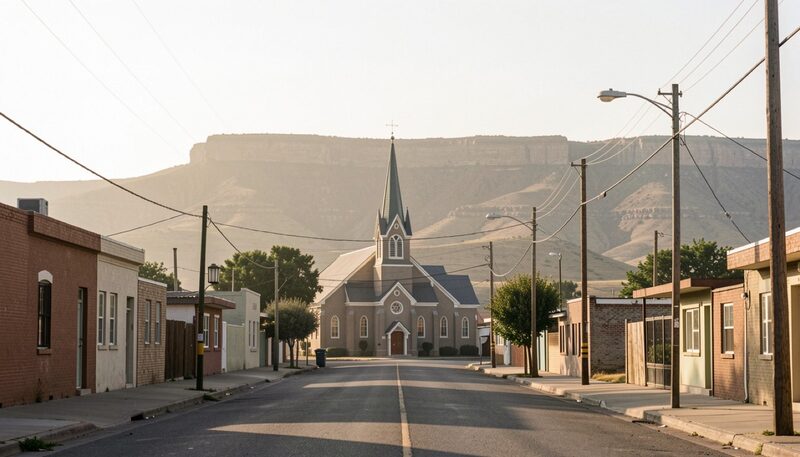
Grand Junction began as a real estate proposition with a surveyor's grid and a promise: the junction of two rivers, a railroad sure to come, and free land for churches willing to build. What followed in the 1880s was one of the faster church planting episodes in the American West. Within roughly two years of the townsite's platting in late 1882, most of the denominations that still mark the city's downtown had organized congregations, and their buildings became the town's first permanent public architecture.
A townsite with room for churches
The Ute removal of 1881 opened the Grand Valley to Anglo settlement, and Grand Junction was platted the following year at the confluence of the Gunnison and the Grand, the river now called the Colorado. Like other western townsite companies, the founders understood that churches were infrastructure: they signaled permanence to prospective buyers, anchored family settlement and often provided the first roof under which a community could meet. The company's practice of granting lots to congregations, documented in county histories held by Mesa County Libraries, put sacred buildings on the survey map within walking distance of the commercial blocks on Main Street. The Baptists' own parcel negotiations, which moved their first building from a proposed site on government land to Grand Avenue, are traced in the journal's history of the Grand Junction Baptist congregation.
Which denominations organized first
The local press of 1882 and 1883 records a scramble of organizational meetings. Methodists, Presbyterians, Catholics and Baptists all appear in those years, along with smaller groups that met in homes and borrowed halls before they could build. The pattern repeated what had happened a generation earlier in mining towns on the other side of the Continental Divide: a circuit rider or visiting preacher gathered whoever was already in town, a letter went to a denominational board, and a formally organized congregation followed with elected officers. The Baptists enrolled nine members in February 1883, five months after the townsite's founding, a timeline preserved in the Grand Junction News and summarized by the Carnegie Library for Local History. Catholic families in the valley were served by visiting priests before establishing a parish, a sequence familiar across the frontier West, where clergy traveled enormous circuits by horse and rail.
Church buildings as early landmarks
In a young town of frame storefronts and tents, a church with a bell tower was a statement of intent. Congregations built first in wood, then, as the orchard economy produced wealth in the 1890s and 1900s, in brick and stone. Cornerstones were laid with ceremonies that doubled as civic events, and local newspapers reported them in detail, which makes those clippings a reliable dating source for researchers. The Baptists' second building campaign, begun with a cornerstone in 1912 and completed after war, crop failures and influenza delays, is documented in the congregation's history. Similar stories of slow, debt averse building campaigns appear across downtown congregations of the same generation, and several of their sanctuaries still stand within a few blocks of one another.
What churches did for the young town
Before Grand Junction had purpose built schools, halls and libraries, churches supplied them. Congregations hosted lectures, concerts and community meetings, ran Sunday schools that functioned as the town's most consistent childhood education, and organized women's societies whose fundraising and charity work filled gaps no public agency yet addressed. Churches were also the town's social calendar: box socials, ice cream gatherings, choir performances and holiday programs bound a population drawn from many states into something like a community. The temperance movement, strong among Methodists and Baptists alike, made congregations political actors as well, campaigning in the statewide prohibition votes of the early twentieth century. This civic weight is one reason congregational records matter to historians far beyond religious history, a theme developed in the journal's Baptist history section.
How the landscape grew and divided
The twentieth century broadened the city's religious map. New denominations arrived with new migrations, congregations planted daughter churches as neighborhoods spread beyond the grid, and the national divides that ran through American Protestantism, between modernist and fundamentalist currents in the 1920s and among denominational families after midcentury, reproduced themselves locally in subtle ways: which congregation joined which association, which hired which seminary's graduates, which started radio ministries or recovery programs. Grand Junction's growth as the regional hub of western Colorado after the Second World War, with its veterans, energy workers and retirees, added independent congregations, Catholic expansion and eventually newer immigrant communities to the mix. Reading the city's church directories decade by decade, where they survive, gives a surprisingly precise index of the city's own growth.
Where the records live
Three repositories do most of the work for this town. The Carnegie Library for Local History at Mesa County Libraries holds church files, photographs, vertical clippings and the Grand Junction News on the founding era. The Daily Sentinel, the city's newspaper founded in 1893, documented congregational milestones continuously and is searchable for much of its run. And the congregations' own materials, minute books, anniversary booklets and membership registers, survive in a mix of church offices, denominational archives and private hands. Anyone researching a specific congregation should also check city directories, which list clergy and church addresses year by year, and the National Register nominations for any historic church buildings. Readers who hold such records or spot an error in this journal's summaries are invited to write through the contact page, since the record improves with every correction.