Church Community Programs
Survey the programs churches commonly run for their towns: food pantries, youth groups, recovery meetings, ESL classes and seasonal events.
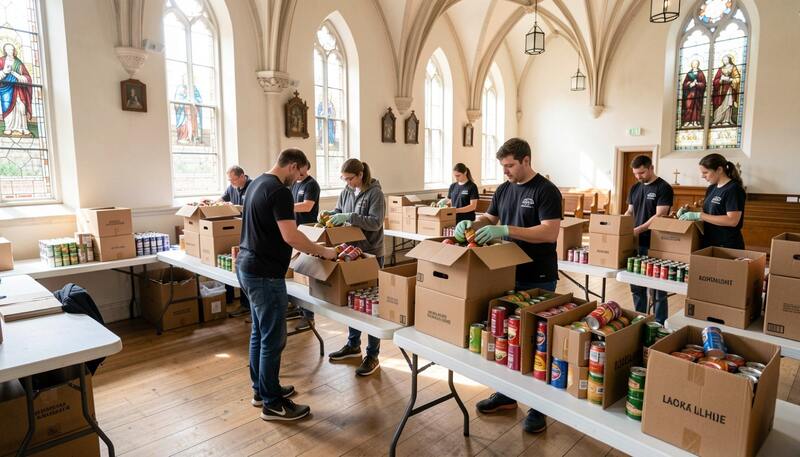
The food pantry line on a weekday morning, the yellow school bus idling outside an after school program, the folding tables of a community dinner: this is the church the neighborhood actually encounters, and no membership required. Congregations across the United States run one of the densest networks of local social programming outside government itself, staffed overwhelmingly by volunteers and funded by offerings rather than grants. This guide surveys the common programs, how they are organized and funded, and what they accomplish, described from the outside as an institutional fact rather than a testimony.
Food security: pantries, meals and gardens
Food assistance is the most widespread congregational program in the country, and it takes three main forms. The food pantry distributes groceries on fixed days, sourcing from regional food banks, which supply member agencies at low cost, alongside purchased goods and community drives. The community meal serves prepared food weekly or monthly, often Saturday or midweek dinners aimed at isolated seniors as much as the hungry; the meals charge nothing and ask nothing. And some congregations host community gardens, offering plots or growing produce for the pantry. Operationally, pantries run on a coordinator, often a part time or volunteer role, a scheduling system, and a rotation of dozens of volunteers, with food safety practices and client confidentiality policies that have professionalized steadily over the decades.
Children and youth programs
The children's programming week typically starts with Sunday school, age graded classes before or after worship, and continues with midweek clubs combining games, snacks and memorization, a format pioneered by twentieth century programs and still recognizable in congregations of every size. Summer brings vacation Bible school, a week of mornings filled with themes, crafts and songs that functions as both childcare relief and community outreach, staffed by volunteer youth and parents. Many congregations add after school tutoring, gym nights, or scouting packs, the long standing hosting arrangement that put troop meetings in church basements for generations. Youth groups for teenagers add trips, service projects and summer camps, and in smaller towns the church youth program is often the main social institution outside school itself.
Adult education and language programs
English as a second language classes rank among the most consequential quiet programs congregations run, taught by trained volunteers, often in partnership with community colleges or literacy councils, and serving immigrant neighbors with no religious condition attached. Alongside them sit citizenship preparation, financial literacy workshops, parenting classes, and recovery programming: Alcoholics Anonymous and similar twelve step meetings hosted in church rooms, or faith based recovery curricula run as structured programs with workbooks and accountability groups. Congregations also field grief support groups and caregiver respite, frequently organized around a trained lay facilitator and a long table with coffee.
Clothing, housing and emergency help
The clothing closet, a room of donated clothes sorted by size and season, appears in congregations of every tradition, often alongside small emergency assistance funds that pay a utility bill or a night of shelter, usually capped per family per year and administered by a deacon board or benevolence committee. Some congregations participate in rotational family shelter networks, hosting homeless families a week at a time in classrooms converted to bedrooms, in partnership with a coordinating nonprofit. Others build homes with Habitat for Humanity style partnerships or send work crews after floods and fires; denominational disaster relief teams, among the most organized volunteer networks in the country, train members in chainsaw work, mud out crews and mass feeding, and deploy across state lines when tornadoes and hurricanes strike. Around the holidays the calendar thickens: Thanksgiving basket assembly lines, Christmas gift programs for families of incarcerated parents, coat drives timed to the first freeze, each requiring a coordinator, a spreadsheet and a small army of seasonal volunteers who appear once a year and are remembered the next.
How the programs are organized and funded
The machinery behind the programs follows a consistent pattern. A committee of members, deacons or a missions board sets policy, a coordinator, paid part time or volunteer, runs operations, and volunteers execute. Funding comes from the congregational budget, which itself comes from member offerings, with designated gifts and occasional grants supplementing. Partnerships multiply capacity: regional food banks, schools that refer families, literacy councils that train tutors, municipalities that provide space or referrals. The characteristic strengths and weaknesses both flow from the volunteer core: congregational programs flex with real need and treat people as neighbors rather than cases, and they also struggle with volunteer burnout, succession when a longtime coordinator steps down, and the professional record keeping that funders increasingly expect, a balance examined further in the journal's guide to how congregations form volunteers.
Why towns look different when churches leave or arrive
The programming footprint explains why congregational closures register as civic events beyond the membership. When a church closes, the town loses a food distribution point, a meeting hall, a scout sponsor and a recovery meeting room at once, and civic organizations spend years replacing what one volunteer institution had quietly provided. Conversely, new congregations often begin their community presence before their building: meeting in schools, running a pantry from a garage, hosting the town's only free tutoring. Readers tracing this civic role historically will find the Grand Junction account in the history of Christianity in Grand Junction, including the early use of church buildings as the town's first public halls, and the congregational governance that makes such programming possible is explained in the journal's guide to Baptist beliefs. The service that anchors the whole week is described in what happens at a Baptist church service.